Agriculture is the backbone of human civilization and remains central to India’s economy, food security and rural livelihoods. As the demand for food continues to grow, an important question confronts modern agriculture: How can we produce enough food while protecting the soil, water, environment and the long-term well-being of farming communities? Two major approaches often dominate this discussion: organic farming and chemical, or conventional farming.
While organic farming focuses on natural processes and organic farming and chemical, or conventional farming. While organic farming focuses on natural processes and reducing dependence on synthetic inputs, chemical farming relies significantly on manufactured fertilisers and pesticides to improve crop nutrition and control pests. Both systems have contributed to agriculture in different ways, and both have their own advantages and limitations. The debate, therefore, should not be reduced to a simple question of which method is “good” and which is “bad”. Instead, it is necessary to understand how these two approaches differ and what those differences mean for farmers, consumers and the environment.
Understanding Organic Farming
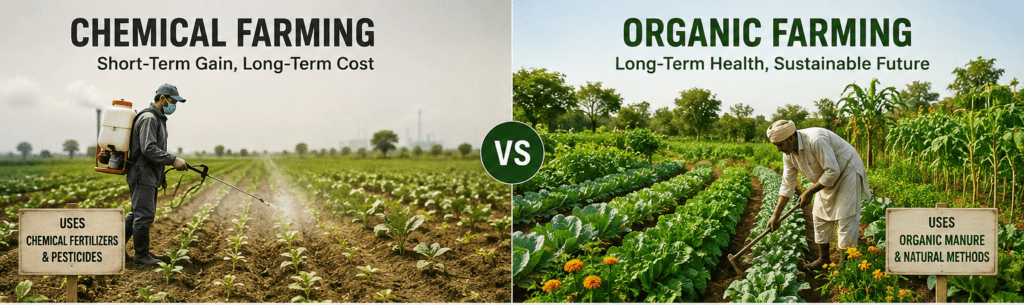
Organic farming is more than simply avoiding chemicals. It is an agricultural system that seeks to work with natural processes while maintaining soil health, biodiversity and ecological balance. Farmers may use practices such as composting, farmyard manure, crop rotation, mulching and biological methods of pest management. The aim is to reduce dependence on synthetic inputs and create a farming system in which natural processes play an important role.
A key feature of organic farming is its focus on the soil. Rather than viewing soil simply as a medium in which crops grow, organic agriculture recognises it as a living system. Organic matter and biological activity are important for maintaining soil fertility over the long term. This approach can also encourage greater biodiversity and the recycling of resources available on the farm.
However, organic farming requires careful planning and management. Simply replacing chemical fertilisers with natural inputs does not automatically make a farming system productive or sustainable. Farmers need knowledge, sufficient organic inputs, appropriate techniques and access to markets to make the transition successful.
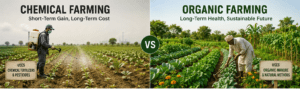
Understanding Chemical Farming
Chemical or conventional farming generally uses synthetic fertilisers and chemical pesticides to support crop growth and protect crops from pests, diseases and weeds. Synthetic fertilisers can provide essential nutrients to plants, while pesticides can help reduce crop losses caused by insects, diseases and other harmful organisms.
The development and use of modern agricultural inputs have contributed significantly to increasing agricultural productivity. In a country such as India, where food security remains an important concern, the ability to increase crop production has played a major role in meeting the food requirements of a large population.
At the same time, concerns arise when these inputs are used excessively or without considering the specific requirements of the soil and crop. Overdependence on chemicals can create environmental challenges and may affect the long-term health of agricultural ecosystems. Therefore, the issue is not necessarily the use of chemical inputs itself, but how responsibly and efficiently they are used.
The Difference Begins with Soil
One of the most important differences between organic and chemical farming lies in the way they approach soil fertility.
Organic farming focuses on improving the soil gradually through organic matter, compost, manure and natural biological processes. The objective is not only to provide nutrients for the current crop but also to maintain the long-term health and fertility of the soil.
Chemical farming, on the other hand, can provide nutrients directly and quickly through synthetic fertilisers. This can be particularly useful when crops require immediate nutrient support. However, when fertilisers are used excessively or without proper soil testing and nutrient management, they can contribute to nutrient imbalances and environmental problems.
For Indian agriculture, protecting soil health is particularly important. Productive farming in the future will depend not only on adding nutrients to crops but also on preserving the quality and biological health of the soil itself.
Productivity: An Important but Complex Question
Productivity is often at the centre of the debate between organic and chemical farming. Chemical-intensive agriculture can support high crop yields because farmers can provide nutrients in readily available forms and respond quickly to pest and disease problems.
Organic farming, however, may require a transition period during which the farming system adjusts to new practices. Yields can vary depending on factors such as the crop, soil, climate, availability of organic inputs and the farmer’s knowledge and management practices. Therefore, it is difficult to make one general statement about whether organic farming will always produce more or less than conventional farming.
For a country like India, this is an especially important issue. Agriculture must support both food security and the livelihoods of farmers. Any transition towards more sustainable practices must therefore be practical and should not place an unfair economic burden on farmers.
Environmental Impact
Organic farming is generally associated with reduced dependence on synthetic fertilisers and pesticides and greater emphasis on biodiversity and ecological processes. By encouraging practices such as crop rotation, composting and biological pest management, it seeks to create a more self-sustaining agricultural system.
Chemical farming can have a greater environmental impact when fertilisers and pesticides are applied excessively or improperly. Nutrient runoff may affect water bodies, while inappropriate use of pesticides can affect ecosystems and non-target organisms.
However, environmental sustainability does not depend only on whether a farm is labelled organic or conventional. The way farming practices are managed matters greatly. A farmer who carefully uses soil testing, precise nutrient application, integrated pest management and water-efficient techniques may significantly reduce the environmental impact of conventional agriculture.
This suggests that the future of farming should focus not only on the type of input used but also on how efficiently, responsibly and scientifically it is used.
The Challenges Faced by Farmers
For farmers, choosing between farming approaches is not always a simple decision. Organic farming may involve challenges such as the availability of organic inputs, the time required for transition, certification requirements, additional labour and the need to access reliable markets. Farmers also need assurance that they will receive fair returns for the effort involved in producing organically.
Chemical farming also presents economic challenges. Farmers may become dependent on purchased inputs such as fertilisers and pesticides, and rising input costs can increase the financial pressure on agricultural households. If inputs are used without adequate knowledge, farmers may spend more without receiving proportionate benefits.
Therefore, farmers need more than instructions about which farming method to adopt. They need access to agricultural extension services, scientific information, affordable inputs, credit, technology and fair markets.
Moving Beyond the “Organic vs Chemical” Debate
The question facing Indian agriculture should not always be framed as a strict choice between organic and chemical farming. India is geographically and agriculturally diverse. A farming method that works well in one region may not be suitable for another.
In some areas, organic farming may offer a strong and sustainable alternative, particularly where farmers have access to local organic resources and suitable markets. In other situations, a gradual transition towards more sustainable farming practices may be more practical.
An integrated approach can combine the strengths of different systems. Farmers can increase the use of organic matter, practise crop diversification and rotation, use biological pest management and improve soil health while also using external inputs carefully and only when necessary. Approaches such as integrated nutrient management and integrated pest management recognise that sustainability and productivity can be pursued together.
The aim should be to reduce unnecessary dependence on harmful practices rather than expecting every farmer to follow an identical model.
The Way Forward for India
India’s agricultural future must balance several urgent priorities: producing enough food, ensuring farmers earn sustainable incomes and protecting natural resources. This will require investment in research, farmer education, soil testing, efficient irrigation, sustainable pest management and locally appropriate farming practices.
Organic farming has an important role to play, particularly in demonstrating the value of healthy soils, biodiversity and resource recycling. At the same time, improving conventional farming through scientific and responsible use of fertilisers and pesticides is equally important.
Government policies, agricultural institutions, NGOs and local communities can contribute by helping farmers access knowledge and practical support. NGOs, in particular, can play an important role in building awareness, connecting farmers with training and markets, encouraging community-based solutions and supporting practices that are suited to local conditions.
Conclusion
Organic farming and chemical farming should not be viewed simply as two opposing sides of agriculture. Each approach has its own strengths, limitations and practical challenges.
Organic farming reminds us that agriculture ultimately depends on healthy soil, biodiversity and functioning ecosystems. Chemical farming demonstrates the importance of scientific innovation and the ability to increase production and protect crops. The real question is how India can use knowledge and technology to ensure that productivity does not come at the cost of long-term environmental damage.
The future of Indian agriculture should, therefore, move towards a system that is productive, economically viable for farmers and environmentally sustainable. Rather than focusing only on “organic versus chemical”, the larger goal should be to create farming practices that protect the land while continuing to feed a growing population.
After all, the success of agriculture should not be measured only by what the soil produces today, but also by what it will be able to produce for generations to come.