For miles and miles, there are no shops or houses. Not even proper trees or plants. Just desolate, barren roads. Far off, you can see the dry and rugged Aravalli hills. Occasionally, there are a few bushes.
I’m in a small car with three other people, heading from Dausa to a village called Pasela in Karauli. Karauli lies in eastern Rajasthan. It is one of the poorest districts in India. Here, 100% of the population lives below the poverty line. And you don’t need data to realize that — it’s etched into every particle of this place. You might see a vehicle only after several kilometers. Though camels are still visible. The roads are empty, no big shops anywhere. In fact, there are no shops for miles. That’s why there’s no roadside litter either.
Today is 7 August 2019. The Karauli visit was planned only on the 4th. I even got confirmed tickets in Udaipur–Khajuraho Express, both onward and return. The train departs Udaipur at 10:20 p.m. and reaches Dausa in the morning, and the return is at 9:45 p.m., reaching Udaipur around 6:30 a.m. Pasela village is about 170 km from Dausa. There’s a meeting of women from nearby villages about their water problems.
At the station, I was picked up by Chaman Singh ji in his car. A woman was sitting in the back and a young boy was driving. No introductions were made. At first, I thought they were also heading to the meeting. But soon I learned they were family. Manju ji, Chaman ji’s wife, told me she had just come along for sightseeing, having never seen this part of Rajasthan. The driver was her son. I thought it would’ve been better if I had taken a hotel room in Dausa for an hour. At least I wouldn’t have had to doze off like this. Soon, an elderly man joined us from the roadside. Everyone called him Baba — a typical Rajasthani elder in white clothes and a large turban. He sat in the front, and the three of us squeezed into the back.
It will take us five hours to reach Pasela. On the way, we passed small towns — a tiny market, a couple of sweet shops, vendors selling roasted maize, peanuts, and chickpeas, puncture repair stalls, and one or two cloth shops. We stopped twice for food. Kachori is the preferred breakfast here. The first one I tried was drenched in curry — didn’t enjoy it at all. Perhaps the oil was old. I refused the second time, but Chaman ji insisted the next stop would be better, and I should try it. Just as I was about to take the first bite, I noticed cow dung right in front of the counter, buzzing with flies, as if they were having a feast. The same flies were sitting on the jalebis inside the shop. That image ruined the taste of the kachori.
About two and a half hours later, we were in the Dang region. From the road, you could see the Aravalli and Vindhya hills, sometimes far off, sometimes the road sliced right through them. The road had become elevated, and the valley stretched below. In this rugged, rocky terrain, whatever little rain falls flows away quickly into small streams and channels, eventually draining into the Chambal River and finally into the sea. The locals, meanwhile, are left thirsty. In this extremely dry region, you see trees only here and there. The rest of the valley is empty.
By around noon, we reached a small temple in Pasela, about 37 km from Karauli. A canopy was set up in front. About 30–35 women were seated there. They had come from villages as far as 7–8 km away, some walking, others on trolleys. A halwai was also there, frying snacks.
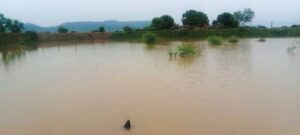
Karauli is facing a severe water crisis. Annual rainfall is only about 600 mm, and that too only during the monsoon. With barely any vegetation, the soil and rocks can’t hold water. So even when it rains, the water doesn’t stay. Groundwater has dropped below 400 feet. Farming here is entirely rainfed — millet is grown only during the few months of rainfall. The rest of the year, fields lie barren. People rear livestock, but by March, when water runs out, even that becomes difficult. Every year, in March, pastoralist families migrate with their animals and children to the Mathura region — risking their children’s education and future. Many locals work as laborers in big cities. With little opportunity for constructive engagement, it’s no surprise that youth here sometimes fall into anti-social activities. No car from another region dares to travel these roads casually.
Access to drinking and irrigation water could transform the present and future of this region. Though 600 mm may seem little, if managed well, it is enough to sustain everyone. These women understand that. But in this backward region, a support system that allows women to step forward may take centuries to build.

Chaman ji has spent over 20 years in this region, mobilizing people and working to stop rainwater from flowing into the Chambal. He has facilitated the construction of about 2,500 small ponds, johads (traditional water bodies), tanks, and anicuts (check dams). Whether he chose this work or it chose him, it seems this mission has consumed him. Today’s meeting is to hear the women out, share experiences, and involve nearby villagers — with heart, with hands, and with shared contributions — in this effort.
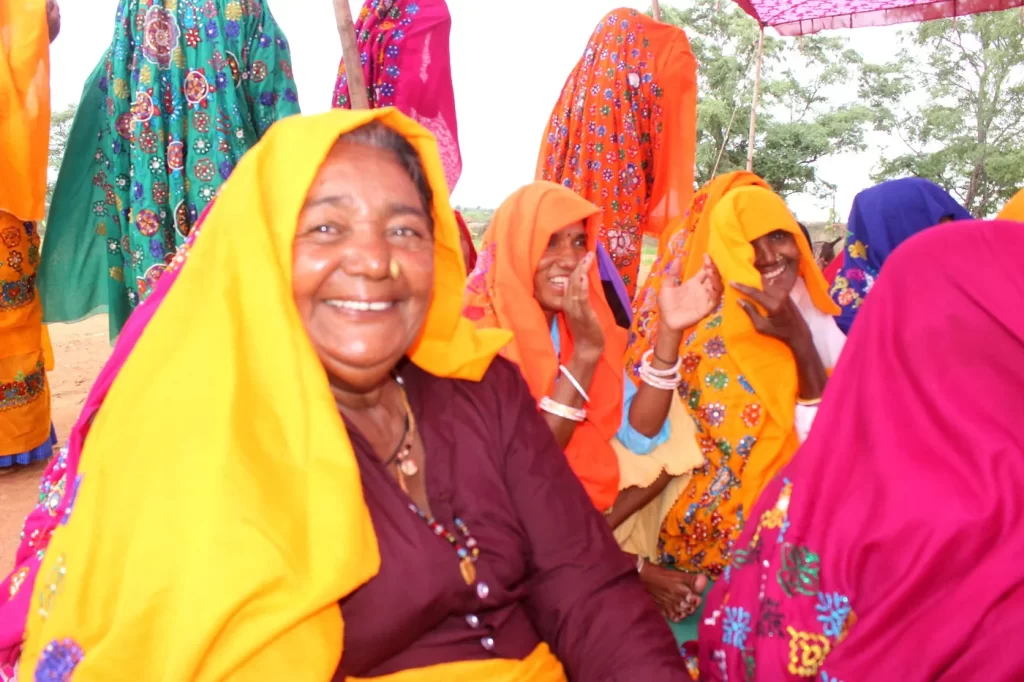
Gradually, about 125 women arrived. In their colorful, shimmering long ghagras, shirts, and embroidered chunris, they brightened up the barren landscape. Some had large nose pins, others thick anklets. Tall, cheerful women of all ages. But when it came time to speak of their struggles, they covered their faces. No one was willing to speak. Why? Because the men were standing nearby. Their mere presence was enough to silence them.
The men were requested to leave so the women could talk. The society is deeply divided — between men and women, and among castes like Meena, Gurjar, etc. But what brought them together was their shared pain — the acute water scarcity. Some walk 4–5 km daily just to fetch water. In June, handpumps barely dripped. Filling a single pot could take hours, sometimes not until evening. One woman shared how water scarcity in June caused her severe stomach pain. Water problems are mainly women’s problems — it’s they who must manage the household and children. That’s why they’ve stepped out of their homes today. Just stepping out itself is a big event.
Once the women started speaking, they all opened up, one after another. It was clear that having water nearby could change every aspect of their lives. They don’t even hope for taps inside their homes — all they want is for water to flow faster from handpumps and for ponds to hold enough for crops and livestock. They want water conservation work to be done in their villages.
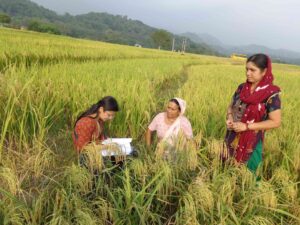
It was amazing to see that all the women knew exactly where and how to store water in their villages. This is their traditional knowledge. Each one pointed out potential spots for ponds, tanks, or johads. They insisted they would contribute labor, money, and convince others at home of the importance of this work.
One woman from Saseri village got emotional. She said that a pond built in April had filled water up to a kilometer. For the first time this year, she will sow wheat. Another woman said a pond built last year allowed her to grow 20 quintals of wheat. These are examples for others. Naturally, all the women wanted the same for their own villages.
Their aspirations and the feasibility of such projects in each village were carefully noted. And thus, Chaman ji’s roadmap for the next year took shape. Thanks to his and his team’s work, perhaps the world’s largest ecological restoration is underway in Karauli — quietly, respectfully, and with deep engagement of local people and traditional knowledge. This region and their work leave a deep imprint on the mind.

Baba sang devotional songs about water. And then it was time to eat — rice pudding, spiced potatoes, and malpua. On our way back, the children arrived — likely returned from school and came straight here looking for their mothers. These kids want to join the army when they grow up. There’s no TV in their homes. They’ve never been to a cinema. But they’ve seen films on mobile phones. Roti, kapda, makaan… and internet! These are Karauli’s “Gully Boys.”
It’s now 4 p.m., and we are preparing to leave. As we started back, several women gathered, trying to hand me ₹20, ₹50, ₹100 notes. Anything could happen here. These women — who have perpetuated harsh traditions — are also the kindest souls. Their societal fabric has defined their lives, where change is happening but slowly. But I don’t want the money. Their presence here is perhaps the beginning. A quiet sense of fulfillment. A hope — that we will meet again.